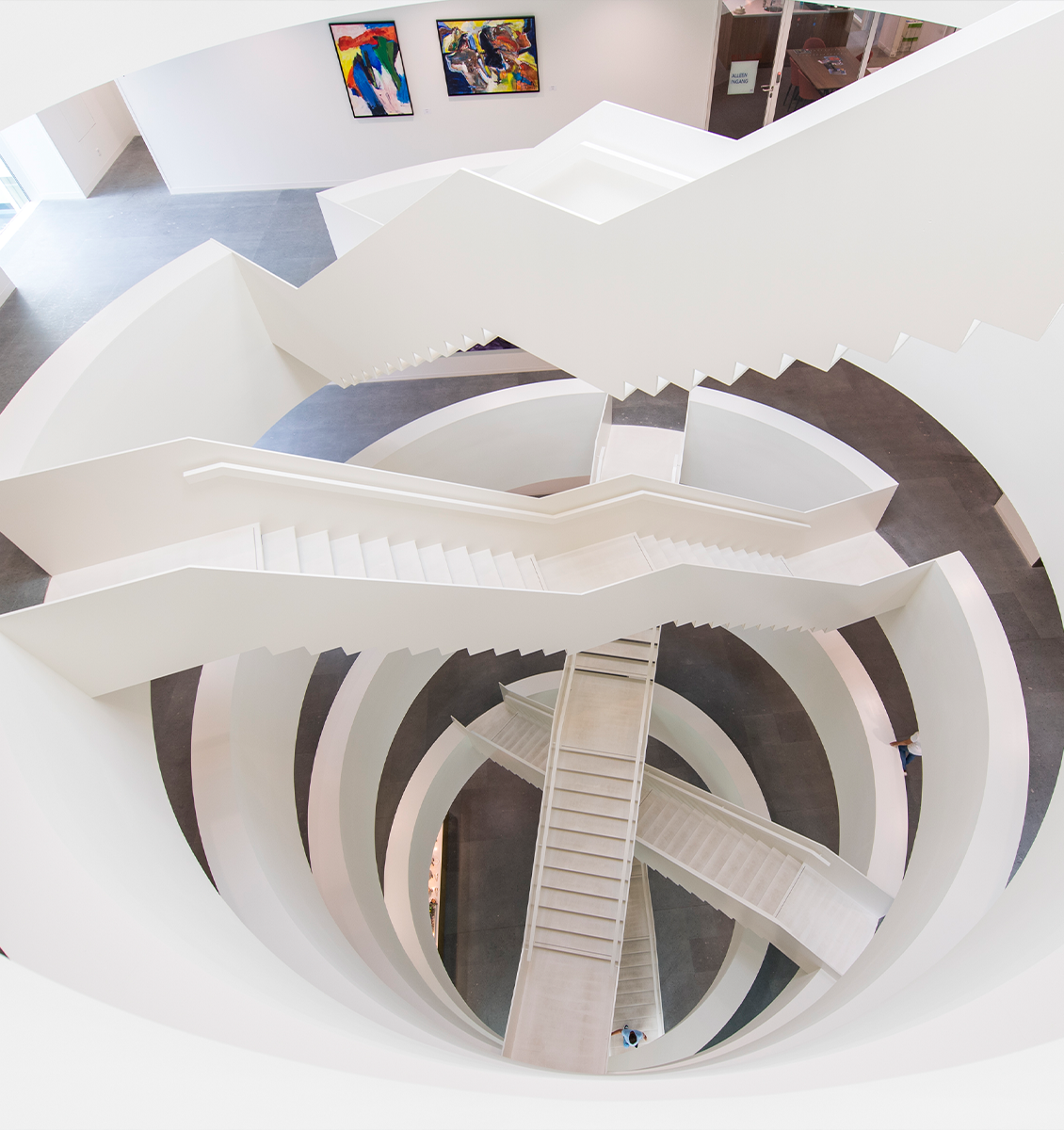
Sustainable choices in the New Court Amsterdam
The role of art in the New Court Amsterdam
In May 2021, the new courthouse in Amsterdam was opened. The building has 10 floors and more than 47,000 m2 of offices, courtrooms, interview rooms, and attached areas. The impressive art collection of the Amsterdam courthouse is displayed throughout the building thanks to the integrated hanging systems from Artiteq.
Transparency and visibility
The New Court has been designed, realized, and is managed through a Public Private Partnership. Consortium NACH is a collaboration between Macquarie Capital, ABT, DVP, KAAN, Heijmans, and Facilicom. Project architect Lisa Goes from KAAN Architects and project manager Leonie van der Waard from Facilicom explain this impressive project.
As project architect, Lisa Goes has worked full-time on the New Court project for almost five years. Lisa: “The court wanted to be visible, recognizable, authoritative, and functional. This resulted in a distinguished building that is simultaneously strikingly transparent and accessible.”
Transparency and visibility were important pillars for the design. “The building opens up to society. Normally, you find a courthouse with a foyer surrounded by various courtrooms and offices. For this building, we turned that principle around. The waiting area for visitors consists of foyers that are located at the large windows of the facades. The courtrooms are therefore in the middle, and the waiting area moves around them.”


Sustainable Choices
The New Court has been tendered by the consortium NACH according to the DBFMO principle (design, build, finance, operate and maintain). Lisa: “The idea of this construction is that you, as a consortium, not only design and deliver the building, but also maintain and manage it for the next 30 to 40 years. This makes it a very special project. You will design and build in a different way. Different choices are made, for example in the area of sustainability.”
The Role of Art in the Court
Sustainable wall management also plays a role in this. The court has an extensive art collection. Additionally, according to the law, a part of the construction budget must be spent on acquiring new art. Lisa: “Together with the art committee of the court, I have been involved in placing the artworks from the own collection in the new building. The committee sees art as a way to help visitors cope with the situation. People are usually present in a courthouse for an unpleasant reason. Art can influence the mood. Paintings can provide reassurance, distract attention for a moment, or offer comfort.”


An integrated hanging system
A number of works from the art collection have found a permanent place in the courtrooms and foyers. In other areas of the building, the committee wanted to display a changing exhibition. Lisa: “Because there was a clear desire from the beginning of the project to incorporate art into the design, we quickly knew exactly where flexible hanging systems were needed. That’s why we could involve Artiteq early in the process and integrate the hanging systems into the design.”
Changing exhibition
In a central location by the escalators, where many people pass by, the changing exhibition can be seen. The architect chose a special black color for the Click Rail Pro there. This rail can carry artworks weighing up to 50 kilograms. Lisa: “The foyer is covered with beautiful natural stone. The ceiling is slightly detached from the wall, creating a shadow edge. The rail is hung higher than the ceiling and is hardly noticeable due to the black color. The goal was to make the system almost invisible here, and that has been achieved.”
Special adapters, hooks & wires
Various products from Artiteq have also been used in the interrogation rooms and offices in the building. Lisa: “In the interrogation rooms, ventilation slats have been installed for air circulation. Artiteq has collaborated with us and designed special adapters for these spaces that fit perfectly into the ventilation holes. We can also attach art to these walls without disturbing the airflow.”
Additionally, built-in rails (Art Strips) have been installed in the interrogation rooms. Finally, Artiteq supplied 1750 hooks and wires for the offices, where drilling into the walls is not allowed. Lisa: “These hanging hooks can easily be hooked over the special system walls in the offices. This allows employees to easily personalize their workspace with their own art.”


Relocation of the art collection
Leonie van der Waard is involved in this project as a project manager for Facilicom: “Together with Heijmans, Facilicom will take care of everything that makes the building pleasant to work in for the next 30 years. We handle matters such as maintenance, acoustics, cleaning, and resolving issues in the building.” Leonie was responsible for coordinating the relocation and hanging the artworks from the court's collection.
Leonie: “The installation of the artworks went excellently. The paintings in the central lobby were hung using a special extra-long ladder. Once the hooks and wires are properly in the rails, attaching the artworks is very simple.” Artworks have also been hung on the walls in the office spaces. Leonie: “I personally helped with hanging the art in the offices. The system is very user-friendly and even suitable for the heaviest artworks.”
The system meets the requirements excellently
The court is very satisfied with the functionality and appearance of the system. Leonie: “I was very surprised by the extensive range of hooks, wires, and solutions from Artiteq. There are also various options for heavier artworks. They have thought along well with us.”
The art committee is also pleased with the result, Leonie knows: “The system meets the requirements set by the committee in terms of flexibility excellently. The changing collection hangs in a beautiful, prominent place. Every three months, the exhibition in the lobby is changed, and that is very easy. Additionally, each department has its own art collection. Once a year, we make a change there. That is very simple, and no drill is involved.”